
- Registered Office:
- Hindustanvision. N.I.T Faridabad
- T : 0129-4176000
- [email protected]


 HindustanVision
Friday,22 May , 2026
HindustanVision
Friday,22 May , 2026

Dr. Prabhat Manocha
NEW DELHI NEWS 22 MAY 2026 : Quantum computing is rapidly evolving from experimental research into a practical engineering reality. While its potential to revolutionize industries is enormous, quantum computing also introduces a fundamental challenge to modern encryption systems that secure digital transactions, payments, identities, communications, and enterprise data.
Today, most digital transactions rely heavily on public-key cryptography algorithms such as RSA and Elliptic Curve Cryptography, or ECC. These algorithms depend on mathematical problems that are computationally infeasible for classical computers to solve efficiently. For example :
RSA relies on the difficulty of factoring extremely large numbers.
ECC relies on the complexity of solving elliptic curve discrete logarithm problems.
AES-256, which is widely used for symmetric encryption
A quantum computer running Shor’s Algorithm could theoretically break widely used public-key encryption technologies much faster than classical systems by efficiently solving factorization and discrete logarithm problems. This means that encryption methods currently trusted across global digital infrastructure may eventually become vulnerable in the quantum era. Cyber criminals are adopting “Harvest Now, Decrypt Later” approach, in which adversaries collect encrypted sensitive data today with the intention of decrypting that data later, once large- scale quantum computers become capable enough.To address these emerging risks, the industry is moving toward Quantum-Safe Cryptography, also known as Post-Quantum Cryptography, or PQC.
Unlike traditional public-key systems, PQC algorithms are designed around mathematical
problems believed to remain resistant even against quantum computers. These include:
Lattice-based cryptography
Hash-based cryptography
Code-based cryptography
Multivariate polynomial cryptography
The National Institute of Standards and Technology, or NIST, finalized its first three post-quantum cryptography standards in August 2024: FIPS 203 ML-KEM, derived from CRYSTALS-Kyber, for key encapsulation; FIPS 204 ML-DSA, derived from CRYSTALS-Dilithium, for digital signatures; and FIPS 205 SLH-DSA, derived from SPHINCS+, for stateless hash-based digital signatures. NIST also selected HQC in March 2025 as an additional backup algorithm for post-quantum encryption, intended to provide cryptographic diversity alongside ML-KEM. Importantly, this transition is not a simple software upgrade. Enterprises must begin immediate preparation for the quantum-safe era by establishing visibility into cryptographic assets, assessing current cryptographic risk, and building the capability to remediate at scale. This includes:
Scanning applications, infrastructure, APIs, certificates, libraries, and code repositories to identify cryptographic artifacts and vulnerabilities.
Creating cryptographic inventory reports, including a Cryptography Bill of Materials, or
CBOM.
Performing dynamic cryptography analysis to evaluate real-world cryptographic usage,
compliance gaps, and quantum exposure.
Prioritizing quantum-vulnerable systems based on business criticality, data sensitivity,
and transaction risk.
Applying best practices for quantum-safe remediation patterns.
Implementing scalable and automated solutions to establish long-term cryptographic
agility.
The future will likely involve hybrid security models, where classical encryption and post-quantum algorithms coexist during transition phases. This hybrid approach will help organizations maintain compatibility while progressively strengthening protection against future quantum threats. So, are transactions safe in the quantum era?
The answer is: transactions can remain safe, but only if organizations begin preparing now.Systems that continue to depend solely on legacy RSA, ECC, and non-agile cryptographic architectures may become vulnerable as quantum capabilities mature. However, organizations that adopt crypto-agility, build cryptographic inventories, implement PQC standards, and modernize their security architecture will be far better positioned to protect digital transactions in the quantum-powered future.
The convergence of Quantum Computing, Artificial Intelligence, Hybrid Cloud, and Quantum- Safe Security will define the next generation of trusted digital infrastructure.
Organizations that begin building quantum-safe readiness today will be better prepared to protect critical systems, financial transactions, citizen services, enterprise applications, and sensitive data in tomorrow’s quantum-enabled world.
 9/22/2026 7:33:36 PM
FARIDABAD NEWS 22 SEP 2026 : GAUTAM : मानव सेवा समिति द्वारा मानव भवन सेक्टर 10 में मंगलवार को एक कार्यक्रम आयोजित किया गया। जिसमें मानव कंप्यूटर सेंटर के 7वें बैच की ट्रेनि Read More...
 9/22/2026 7:30:38 PM
FARIDABAD NEWS 22 SEP 2026 : GAUTAM : महाराष्ट्र मित्र मंडल द्वारा आयोजित सार्वजनिक श्री गणेशोत्सव के अंतर्गत गांधी कॉलोनी स्थित श्री गणेश पार्क में सोमवार, 21 सितम्बर को पं Read More...
 9/22/2026 7:27:32 PM
FARIDABAD NEWS 22 SEP 2026 : GAUTAM : संयुक्त निदेशक दुष्यंत पांडे ने दीप प्रज्वलन तथा भगवान धन्वंतरि को माल्यार्पण कर पुष्प अर्पित किये, दुष्यंत पांडे Read More...
 9/22/2026 7:20:04 PM
कृषि मंत्री श्याम सिंह राणा ने कहा—फसल बेचने आ रहे किसानों को मिलें सभी सुविधाएं
FARIDABAD NEWS 22 SEP 2026 : GAUTAM : हरियाणा सरकार में खाद्य, नागरि
Read More...
 9/22/2026 7:17:02 PM
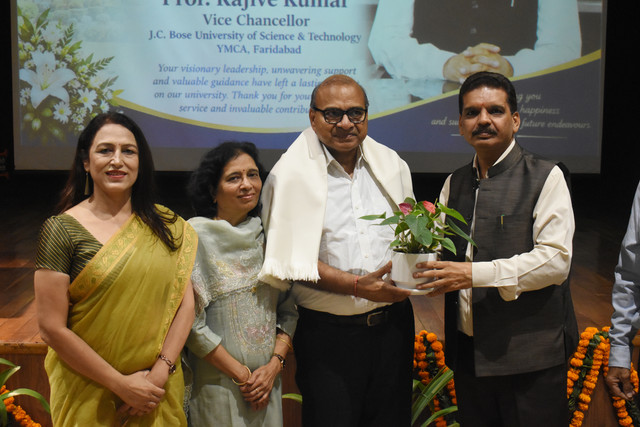
FARIDABAD NEWS 22 SEP 2026 : GAUTAM : J.C. Bose University of Science and Technology, YMCA, Faridabad, organized a heartfelt farewell ceremony to honour the tenure of its ou Read More...
 9/21/2026 10:20:00 PM
PALWAL NEWS 21 SEP 2026 : GAUTAM : सहकार भारती के राष्ट्रीय अध्यक्ष डॉ. उदय जोशी के कुशल मार्गदर्शन में सहकार भारती, दी हरियाणा स्पोर्ट्स कोऑपरेटिव लीग मल्टीपर्पस सोसायटी लि Read More...
 9/21/2026 9:33:19 PM
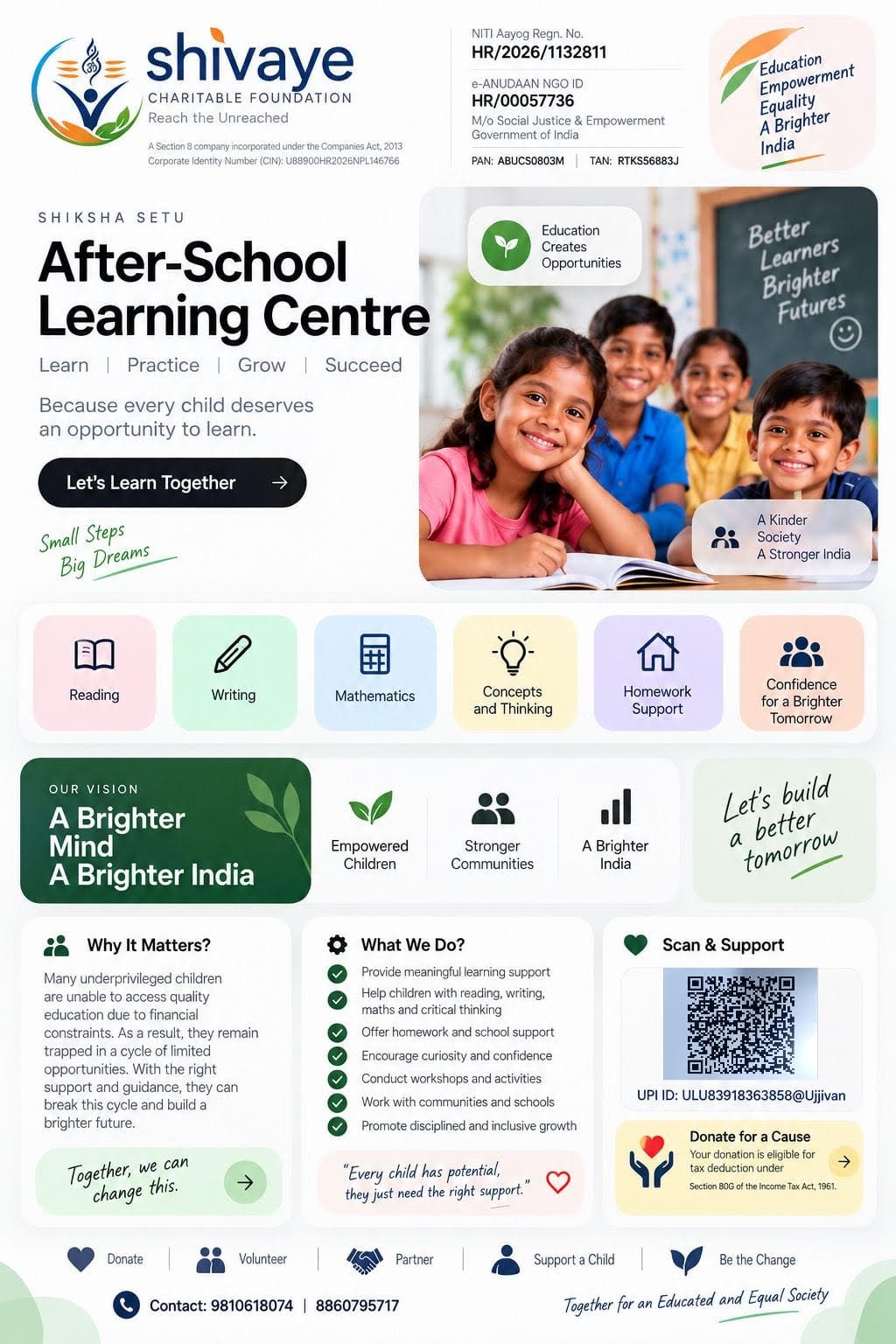
शिवाय चैरिटेबल फाउंडेशन की पहल, वंचित एवं जरूरतमंद बच्चों के लिए स्कूल के बाद शैक्षणिक सहयोग
NEW DELHI 21 SEP 2026 : GAUTAM : गरीब एवं Read More...
 9/21/2026 9:30:08 PM
FARIDABAD NEWS 21 SEP 2026 : GAUTAM : आयुष विभाग, ईएसआईसी मेडिकल कॉलेज एवं अस्पताल, फरीदाबाद में 11वें आयुर्वेद दिवस के आयोजन के उपलक्ष्य में आज तीन दिवसीय कार्यशाला का शुभा Read More...


